Wound Care Market Size & Share Analysis - Trends, Drivers, Competitive Landscape, and Forecasts (2026 - 2032)
This Report Provides In-Depth Analysis of the Wound Care Market Report Prepared by P&S Intelligence, Segmented by Product Type (Advanced, Traditional, Wound Closure), Wound Type (Diabetic Foot Ulcer, Pressure Ulcer, Surgical & Traumatic Wound, Burn, Venous Leg Ulcer), Age Group (Under 14, 14, 50, 65, 75, Above 80), End User (Hospital & Clinic, Homecare Setting, Long-Term Care Settings), and Geographical Outlook for the Period of 2021 to 2032
Explore the market potential with our data-driven report
Wound Care Market Key Insights
The advanced category held the largest share in 2025, of 60%, and it is projected to register the highest CAGR during 2026–2032, of approximately 5.8%.
The above 80 category held the largest revenue share in the global wound care market in 2025, of 35%.
The 14–49 category is projected to exhibit the fastest growth during 2026–2032, at approximately 6.0% CAGR,
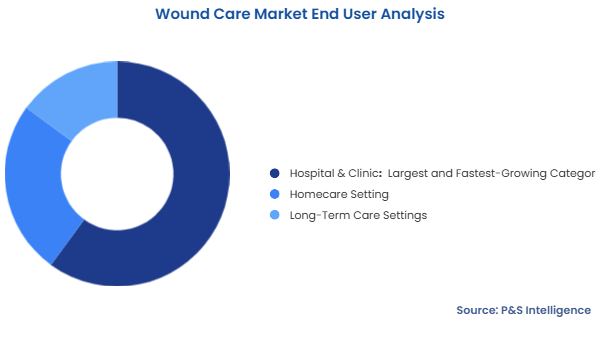
Hospitals & clinics held the largest share in 2025, of 60%, and they will have the highest CAGR during 2026–2032, of approximately 5.8%
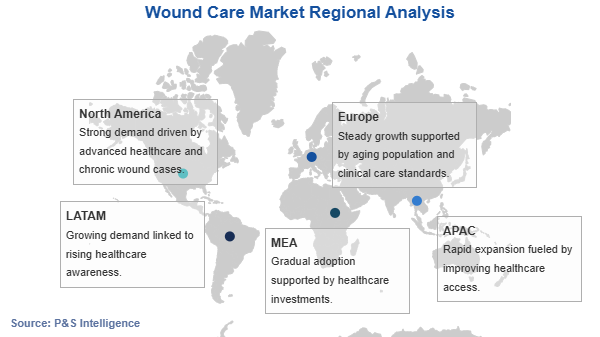
North America is the largest region in the market with 40% share in 2025.
Asia-Pacific is the fastest-growing market, with approximately 6.5% CAGR during 2026–2032.
Wound Care Market Future Outlook
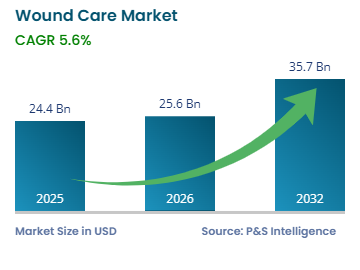
The global wound care market size stood at USD 24.4 billion in 2025 and is projected to reach USD 35.7 billion by 2032, expanding at a CAGR of 5.6% over 2026–2032. The escalating global burden of chronic and acute wounds is intensifying demand for advanced wound management solutions across hospitals, homecare settings, and long-term care facilities worldwide.
The rising prevalence of diabetes expands the population at risk for diabetic foot ulcers and other chronic wound conditions requiring prolonged clinical intervention. The International Diabetes Federation (IDF) estimates that 537 million adults were living with diabetes globally as of 2021. This population carries disproportionate risk for lower-extremity ulceration and impaired wound healing. The International Diabetes Federation (IDF) estimates that the global diabetic population will reach 783 million by 2045. The growing geriatric demographic compounds this pressure. Compromised skin physiology in older patients lengthens healing timelines, increasing dependence on extended clinical wound management.
Advanced biologics, including skin substitutes and growth factor therapies, alongside negative pressure wound therapy (NPWT) systems and antimicrobial dressings, are displacing conventional gauze-based approaches in complex wound management. Wound care products are increasingly compatible with homecare delivery, with portable devices and remote monitoring platforms extending the treatment continuum beyond inpatient boundaries.
Wound Care Market Trends and Drivers
Advanced Biologics and Technology-Integrated Products Are Trending
Healthcare providers are replacing conventional gauze-based dressing approaches with advanced biologics and NPWT systems in complex wound management. Biological skin substitutes, growth factor therapies, and collagen-based wound matrices are gaining adoption in hospital settings managing diabetic foot ulcers (DFUs) and venous leg ulcers, where standard dressings fail. NPWT technology has become the standard of care in post-surgical and complex wound management across North America and Europe. The global negative pressure wound therapy market stood at approximately USD 3.4 billion in 2025 and is projected to reach USD 5.3 billion by 2032.
Single-use portable NPWT devices are further extending their clinical reach into homecare and ambulatory settings. Sensor-integrated dressings capable of detecting wound biomarkers, moisture levels, and bacterial burden are entering clinical practice and are positioned to shift wound assessment from periodic clinical review to continuous real-time monitoring. This technological evolution is elevating average unit selling prices across the product spectrum. Improved patient outcomes are reinforcing payer adoption of premium wound care formats.
Rising Chronic Disease Burden and Surgical Volumes Propel Market
Diabetes, obesity, and cardiovascular disease compromise wound healing capacity and elevate the incidence of chronic ulcerations requiring long-term management. Diabetic foot ulcers develop in 15–25% of the global diabetic population. Their recurrence necessitates continuous product use across multiple wound care categories, from advanced dressings and NPWT systems to biological skin substitutes.
The WHO reports that over 1 billion people worldwide were living with obesity in 2024, equivalent to approximately one in eight individuals globally. About 890 million adults, or 16% of the global adult population, were obese in 2022, while roughly 2.5 billion adults, or 43%, were overweight. Prevalence has more than doubled among adults and quadrupled among children and adolescents since 1990. Some 35 million children under the age of five are classified as overweight.
The World Obesity Federation reports that around 159 million individuals aged 5 to 19 are living with obesity. Chronic inflammation and reduced peripheral blood flow impair wound healing capacity in obese patients. Altered immune function slows tissue repair and elevates infection risk. These mechanisms increase the susceptibility of obese individuals to chronic and complex wounds.
Rising global surgical volumes are generating post-operative wound management requirements. The WHO estimates that 313 million surgical procedures are performed globally each year. Surgical site infections affect 2–5% of operated patients and extend treatment duration. The combined pressure from chronic wound chronicity and acute surgical wound incidence ensures a demand base that expands consistently with both population aging and healthcare access improvements.
Homecare Expansion and Emerging Markets Opening New Growth Pathways
The decentralization of wound care delivery from hospital inpatient settings toward homecare and ambulatory care environments is a key market opportunity. Demand is growing for wound care products engineered for patient self-administration and remote care protocols. Reimbursement policy reforms in the United States under the Centers for Medicare & Medicaid Services (CMS) telehealth-billable caregiver training codes and similar homecare funding initiatives in Canada, the United Kingdom, and Germany are removing the economic barriers confining advanced wound therapies to institutional settings. These policy changes are generating demand for product formats specifically designed for lay caregiver use. Market participants are actively developing and commercializing compact NPWT devices, pre-filled canister dressings, and color-coded application kits.
The underpenetrated wound care markets of South Asia, Southeast Asia, Latin America, and Sub-Saharan Africa represent substantial growth potential for both advanced and traditional wound care products. Healthcare infrastructure investment in these geographies is improving access to clinical wound management in populations carrying disproportionate chronic wound burdens. The International Labour Organization (ILO) estimates that 270 million workplace accidents occur globally each year. This accident burden generates a persistent acute wound demand stream in markets where occupational safety infrastructure remains underdeveloped.
Costly Advanced Therapies and Uneven Reimbursement Coverage Hamper Adoption
Advanced wound care products, including biologics, NPWT systems, and bioengineered skin substitutes, deliver clinical superiority over conventional dressings but carry substantially higher costs. These costs create substantial access barriers in low- and middle-income healthcare environments. The high cost of biological skin substitutes places them beyond reach for the majority of healthcare facilities in emerging economies reliant on public funding. Public health systems in developing countries continue to provision wound management with traditional gauze-based dressings, even where clinical evidence supports advanced product adoption.
Reimbursement fragmentation compounds this barrier. Coverage for advanced wound therapies under national health systems varies widely across geographies. Coverage exclusions for homecare NPWT use in multiple European countries limit adoption outside hospital settings. The WHO estimates that at least half the world's population cannot obtain essential health services without financial hardship. This coverage gap limits wound care market penetration in price-sensitive regions.
Wound Care Market Segmentation Analysis
Product Type Analysis
The advanced category held the largest share of the global wound care market in 2025, of 60%, and it is projected to register the fastest growth during 2026–2032, at approximately 5.8% CAGR. This is owing to the clinical superiority of these products and caregivers and patients’ shift away from conventional wound management approaches. Their popularity is driven by their effectiveness on numerous wound types, strong payer support in developed markets, and introduction of new products that elevate average revenue per patient episode.
Advanced dressings create a moist environment, which reduces healing time relative to dry gauze. NPWT devices and biologics address complex wounds, where standard approaches fail. The U.S. Food and Drug Administration (FDA) has cleared various antimicrobial dressings, bioengineered skin substitutes, and NPWT systems, which directly supports clinical adoption and payer coverage decisions. The Agency for Healthcare Research and Quality (AHRQ) reports that more than 2.5 million Americans develop pressure ulcers annually, creating a long-term demand for advanced dressings and biologics.
The segment has the following categories:
Advanced (Largest and Fastest-Growing Category)
Dressing
Foam
Hydrocolloid
Film
Alginate
Antimicrobial
Hydrogel
Collagen
Hydrofiber
Wound contact layer
Superabsorbent
Others
Therapy Device
Negative Pressure Wound Therapy (NPWT) Device
Pressure Relief Device
Others
Biologic
Skin Substitute
Growth Factor
Collagen-based
Others
Traditional
Bandage
Fixation Tape
Gauze
Sponge
Abdominal Pad
Others
Wound Closure
Suture
Hemostat
Surgical Staple
Adhesive & Tissue Sealant
Wound Closure Strip
Wound Type Analysis
DFUs commanded the largest revenue share in 2025, of 35%, and they are expected to register the highest growth rate during 2026–2032, of approximately 6.2%. The global diabetes epidemic expands the DFU patient population, thus propelling the demand for more advanced and costly treatment protocols. DFUs are characterized by high chronicity, frequent recurrence, and elevated amputation risk, which extends the per-patient treatment window and multiplies the consumption of dressings, debridement devices, biologics, and NPWT systems.
A single unresolved DFU episode can require treatment spanning months to years, generating far greater per-patient revenue than acute wound types. According to the American Diabetes Association (ADA), approximately 80% of non-traumatic lower limb amputations in the United States occur due to diabetes-related complications. This highlights the risks of DFUs and the criticality of treating them promptly and effectively with advanced wound care products.
The segment has the following categories:
Diabetic Foot Ulcer (DFU) (Largest and Fastest-Growing Category)
Pressure Ulcer
Surgical & Traumatic Wound
Burn
Venous Leg Ulcer (VLU)
Others
Age Group Analysis
The above 80 category held the largest revenue share in the global wound care market in 2025, due to their disproportionately high wound burden. These individuals experience severely compromised skin integrity, prolonged immobility, polypharmacy interactions, and high prevalence of comorbidities, including diabetes, peripheral vascular disease, and malnutrition. These factors translate into higher wound incidence and longer healing timelines, driving the usage of advanced dressings, pressure relief devices, and biologics. The WHO further reports that this number is projected to reach about 434 million by 2050 from 125 million in 2020.
The 14–49 category is projected to exhibit the fastest growth during 2026–2032, at approximately 6.0% CAGR, driven by the rising rates of trauma-related acute wounds, occupational injuries, and surgical procedures. Additionally, their rising disposable income, growing awareness of advanced wound care, and improving health insurance coverage in emerging markets drive this category. Urbanization, increasing participation in high-risk sports, and greater access to healthcare facilities further contribute to the demand for advanced wound management solutions. Moreover, the technological innovations in wound dressings, including antimicrobial dressings and NPWT systems, are encouraging adoption among this age group for faster recovery and improved outcomes.
The segment has the following categories:
Under 14
14–49 (Fastest-Growing Category)
50–64
65–74
75–80
Above 80 (Largest Category)
End User Analysis
Hospitals & clinics held the largest share of the global wound care market in 2025, of 60%, and they will have the fastest growth during 2026–2032. This reflects the irreplaceable role of hospitals in complex wound management and the rapidly expanding investment in hospital capacity and outpatient wound care center development globally. Hospitals handle large patient populations and possess the clinical expertise and advanced equipment required for wounds demanding intensive interventions. Therefore, these places treat high volumes of post-surgical wounds requiring NPWT, diabetic foot ulcers requiring debridement and biologics, and burn injuries requiring specialized care protocols.
The preference of market players and payers to validate and reimburse advanced wound therapies within hospitals reinforces this category’s dominance. Ambulatory surgical centers and outpatient wound care clinics are quite significant in North America, driven by CMS reimbursement incentives, which reward shorter inpatient episodes and encourage outpatient wound management. The CMS has expanded reimbursement frameworks for advanced wound care products in outpatient hospital settings, including wound dressings and NPWT.
The segment has the following categories:
Hospital & Clinic (Largest and Fastest-Growing Category)
Homecare Setting
Long-Term Care Settings
Drive strategic growth with comprehensive market analysis
Wound Care Market Geographical Analysis
North America Wound Care Market Outlook
North America is the largest region in the market with 40% share in 2025. This is due to the high per capita healthcare expenditure and established reimbursement pathways for advanced wound therapies, including NPWT and biological skin substitutes, under Medicare and Medicaid.
Federal value-based care contracts under CMS bundled payment programs incentivize hospitals to adopt cost-efficient, advanced wound solutions, as readmission reduction from wound complications is tied directly to reimbursement rates. According to the Centers for Disease Control and Prevention (CDC), approximately 38.4 million people in the United States have diabetes, with nearly 1 in 5 cases remaining undiagnosed.
The region’s aging population with high susceptibility to pressure injuries and venous leg ulcers also drives the market. Canada contributes a growing share, with provincial health systems initiating NPWT reimbursement pilots for homecare settings, which improves access to advanced wound care therapies. According to Diabetes Canada, approximately 3.7 million Canadians are living with diabetes. This figure is projected to grow as rates of obesity and sedentary lifestyle rise among the adult population, thus expanding the market.
U.S. Wound Care Market Growth
The United States constitutes the largest market, benefiting from a regulatory environment that actively accelerates innovation. The FDA’s 510(k) clearance pathway and Breakthrough Device designation expedite access to next-generation wound care products, including biosynthetic dressings and AI-integrated wound assessment platforms. The post-pandemic surgical volume recovery has reinforced hospitals’ demand for advanced wound closure products and post-operative dressings, while the growth in outpatient procedures is driving demand from ambulatory surgical centers.
The shift toward home-based wound management, supported by wearable sensor-integrated dressings and telehealth-coordinated care protocols, is opening an expanding distribution channel outside traditional inpatient boundaries. Private insurers and Medicare Advantage plans now incorporate remote wound monitoring reimbursement codes, removing a key economic barrier to broader homecare adoption. The FDA has authorized more than 1,000 AI-enabled medical devices with wound assessment, imaging, and monitoring functionalities as of January 2025. This catalyzes the clinical adoption of technology-integrated wound care solutions across hospitals and outpatient settings.
Europe Wound Care Market Analysis
Europe’s market is driven by demographic aging, high prevalence of venous insufficiency and diabetes-related ulcers, and government-supported chronic wound management programs. The EU Medical Device Regulation (MDR) has elevated clinical evidence requirements for wound care products. This has raised the competitive barrier for undocumented therapies, while creating long-term commercial advantage for manufacturers with validated outcome data. According to the International Diabetes Federation (IDF), approximately 66 million adults in Europe are living with diabetes. Prevalence is rising due to the increasing rates of obesity and sedentary behavior, thus propelling the demand for diabetic ulcer care, advanced dressings, and wound therapy devices.
In Europe, the share of people aged 80 years and over increased from 3.8% to 6.1% of the population between 2004 and 2024, as per the EU’s Eurostat. The WHO states that nearly 60% of the adults in the region are either overweight or living with obesity. Moreover, obesity leads to over 1.2 million deaths annually across Europe, with the prevalence increasing with age.
Germany is the largest country market, sustained by its universal statutory health insurance system, strong home-based wound care infrastructure, and presence of leading market players. The United Kingdom is the fastest-growing market, driven by the National Health Service’s outcome-based wound care protocols, community nursing expansion for post-surgical wound management, and growing private investment in advanced biologics.
Asia-Pacific Wound Care Market Forecast
Asia-Pacific represents the fastest-growing regional market, with 6.5% CAGR during 2026–2032. This is underpinned by an expanding diabetic population, rising public and private healthcare investment, and improving access to advanced wound care products across China, India, Japan, South Korea, and Australia. The government-led healthcare infrastructure programs in China and India are broadening the availability of specialty wound care services beyond tier-1 cities, thus expanding the patient base into underserved markets.
The International Diabetes Federation (IDF) projects that the Asia-Pacific region will account for the largest share of the global diabetes population by 2045, with China and India together accounting for approximately 300 million diabetic adults. This propels the demand for DFU management products and chronic wound therapies. The WHO further estimates that road traffic collisions cause 1.19 million deaths annually worldwide, mostly in Asia-Pacific. This creates a sustained demand for acute wound management solutions, including trauma dressings, wound closure products, and hemostatic agents.
Japan and South Korea benefit from advanced healthcare systems with established reimbursement frameworks for wound care devices. Australia has directed federal funding toward chronic wound management in response to the 450,000 Australians living with active wound conditions. The increasing local manufacturing of wound dressings and devices in China and India is also improving product affordability, in turn, accelerating penetration in price-sensitive markets.
China Wound Care Market Overview
China constitutes the largest country market within Asia-Pacific, driven by its huge diabetic population, rapid expansion of hospital-based wound care services, and rising government investment in healthcare infrastructure. The country’s massive, under-treated burden of DFUs, pressure injuries, and surgical wounds drives product launches and distribution partnerships from global and domestic producers. The local manufacturing capability for wound dressings, gauze, and traditional wound closure products is well-established. However, advanced NPWT devices, biologics, and antimicrobial dressings are predominantly supplied by international brands through hospital tenders and distribution agreements.
Urbanization is channeling wound care demand into tier 1 and tier 2 city hospitals, while the expanding community health center networks are improving rural access to basic wound management products. Reimbursement policy expansion under the National Healthcare Security Administration is broadening the coverage for advanced wound therapies, reducing out-of-pocket expenses for poor patients. The National Bureau of Statistics of China reports that China’s population aged 60 and above reached 297 million in 2023, accounting for 21% of the total. This demographic with a disproportionately high chronic wound prevalence sustains the demand for advanced dressings, pressure relief devices, and wound biologics across hospitals and long-term care settings.
India Wound Care Market Dynamics
India represents the fastest-growing country market within Asia-Pacific, driven by a rapidly expanding diabetic population, substantially unmet advanced wound care needs, and rising public health investment. According to the Indian Council of Medical Research (ICMR), approximately 101 million people in India are living with diabetes, with the burden projected to exceed 130 million by 2045. This is contributing to a growing patient base for chronic wound management products, including DFU-specific dressings, biologics, and NPWT devices.
The Ayushman Bharat Pradhan Mantri Jan Arogya Yojana (PM-JAY) scheme is improving the affordability of wound-related procedures for lower-income patients. The growing network of private hospitals and specialty wound care clinics in Mumbai, Delhi, Bangalore, and Hyderabad propels the demand for advanced dressings, NPWT systems, and biological wound care products. The rising medical professional awareness of diabetic foot complications, supported by national diabetes society programs and clinical training initiatives, is improving early care-seeking behavior.
The market covers the following regions and countries:
North America (Largest Region)
U.S. (Largest Country Market)
Canada (Fastest-Growing Country Market)
Europe
Germany (Largest Country Market)
U.K. (Fastest-Growing Country Market)
France
Italy
Spain
Rest of Europe
Asia-Pacific (Fastest-Growing Region)
China (Largest Country Market)
India (Fastest-Growing Country Market)
Japan
South Korea
Australia
Rest of Asia-Pacific
Latin America
Brazil (Largest Country Market)
Mexico (Fastest-Growing Country Market)
Rest of Latin America
Middle East & Africa
Saudi Arabia (Largest Country Market)
South Africa
U.A.E. (Fastest-Growing Country Market)
Rest of MEA
Wound Care Market Share Analysis
The global wound care market is moderately fragmented with multiple leading multinational companies, regional manufacturers, specialty producers, and private-label suppliers. The product diversity prevents any single company from establishing dominance across the full product spectrum. This is because no company offers everything, including traditional dressings, advanced biologics, wound therapy devices, and wound closure systems. Additionally, the varying government regulations, reimbursement environments, and clinical adoption patterns across countries create a natural territory for regional specialization, alongside global incumbents.
The high regulatory barriers for advanced biologics and medical devices sustain established manufacturers with validated clinical evidence portfolios. On the other hand, the traditional and wound closure segments remain accessible to regional players with lower-cost manufacturing capabilities. Within the leading tier, competitive differentiation follows distinct strategic lines. The mid-tier comprises players with more specialized or regionally concentrated positions. Competitive intensity is the highest within the advanced dressing and NPWT segments, where product differentiation, clinical evidence requirements, and payer coverage decisions determine market access and commercial success.
Leading Companies in the Wound Care Market:
Hollister Incorporated
DeRoyal Industries Inc.
ConvaTec Group plc
Smith & Nephew PLC
Molnlycke Health Care AB
3M Company
Essity AB
Paul Hartmann AG
B. Braun SE
Coloplast A/S
Beiersdorf AG
Integra LifeSciences Holdings Corporation
Wright Medical Group N.V.
Johnson & Johnson
Solventum Corporation
Wound Care Market News
In December 2025, Solventum Corporation announced the acquisition of Acera Surgical for USD 850 million, adding the latter’s synthetic bioabsorbable tissue matrices for complex wound repair to its portfolio.
In October 2025, ConvaTec Group plc announced plans to invest more than USD 1 billion over the next decade to expand its global R&D capabilities. This includes a USD 600 million investment in the United States, alongside a 50% capacity expansion of its R&D facility in Boston, aimed at accelerating innovation in advanced wound care and chronic care solutions.
In October 2024, Molnlycke Health Care AB completed the acquisition of P.G.F. Industry Solutions GmbH, the manufacturer of Granudacyn wound cleansing and moisturizing solutions, expanding its capabilities in wound cleansing and preparation for acute and chronic wounds.
In September 2024, Solventum Corporation launched the V.A.C. Peel and Place Dressing, an all-in-one integrated dressing and drape system compatible with its NPWT platform. It features a built-in non-adherent perforated layer for less painful removal and a clinical application time of under two minutes.
Frequently Asked Questions About This Report
What will be the wound care market 2032 size?+
In 2032, the market for wound care will value USD 35.7 billion.
Which product type leads the wound care industry?+
Advanced products dominate the wound care industry with 60% revenue.
Which is the largest region in the wound care market?+
North America is the largest market for wound care, with 40% share.
What are the key wound care industry drivers?+
The global wound care industry is driven by rising prevalence of chronic and acute wounds, diabetes, and obesity, growing surgical procedures and trauma cases, advancing wound care technologies, rising healthcare spending, and increasing awareness of advanced wound management solutions.
What is the wound care market nature?+
The market for wound care is moderately fragmented.
Want a report tailored exactly to your business need?
Leading companies across industries trust us to deliver data-driven insights and innovative solutions for their most critical decisions. From data-driven strategies to actionable insights, we empower the decision-makers who shape industries and define the future. From Fortune 500 companies to innovative startups, we are proud to partner with organisations that drive progress in their industries.
Client Testimonials
Working with P&S Intelligence and their team was an absolute pleasure – their awareness of timelines and commitment to value greatly contributed to our project's success. Eagerly anticipating future collaborations.
McKinsey & Company
India
Unmatched Standards
Our insights into the minutest levels of the markets, including the latest trends and competitive landscape, give you all the answers you need to take your business to new heights
Complete Data Security
We take a cautious approach to protecting your personal and confidential information. Trust is the strongest bond that connects us and our clients, and trust we build by complying with all international and domestic data protection and privacy laws